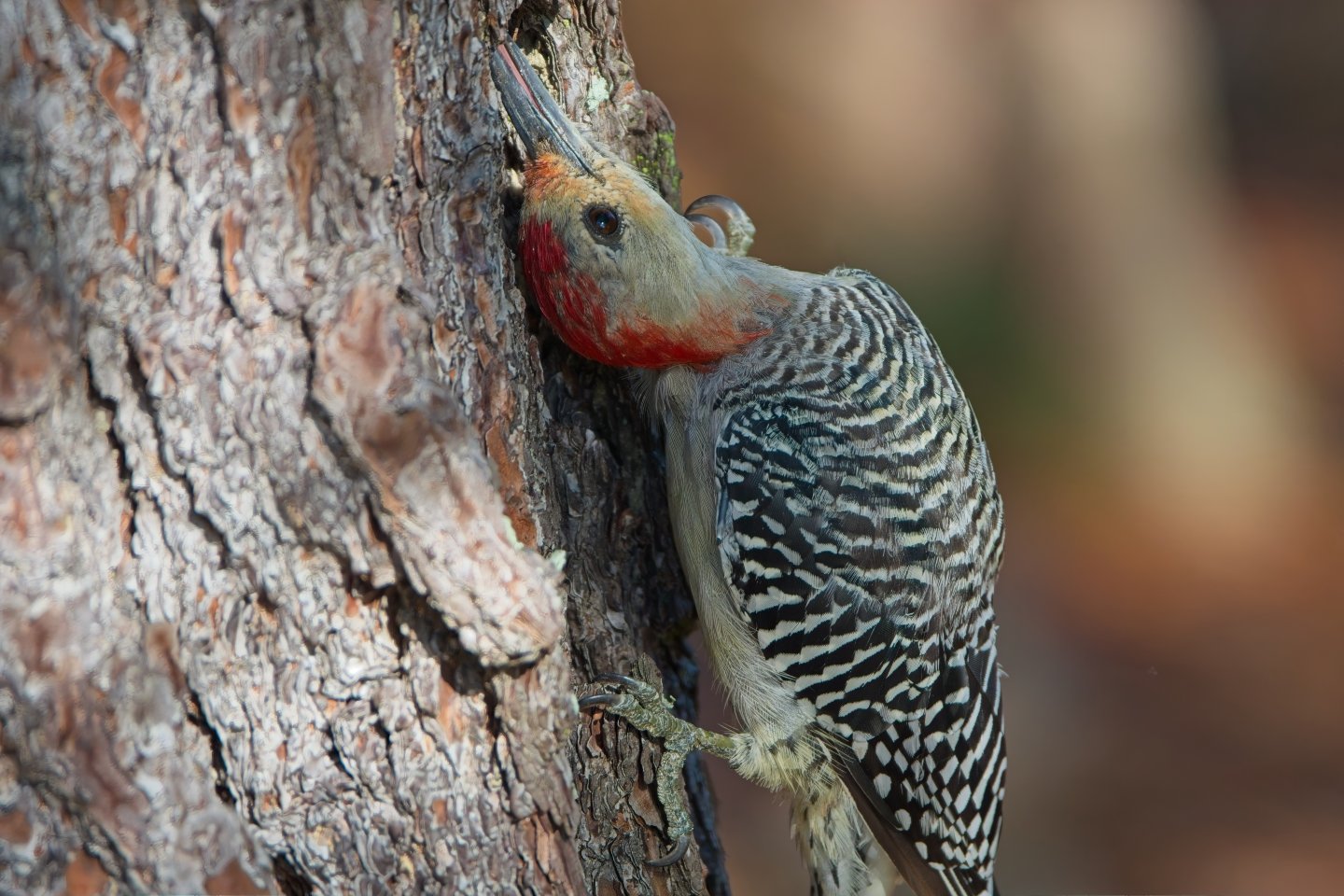
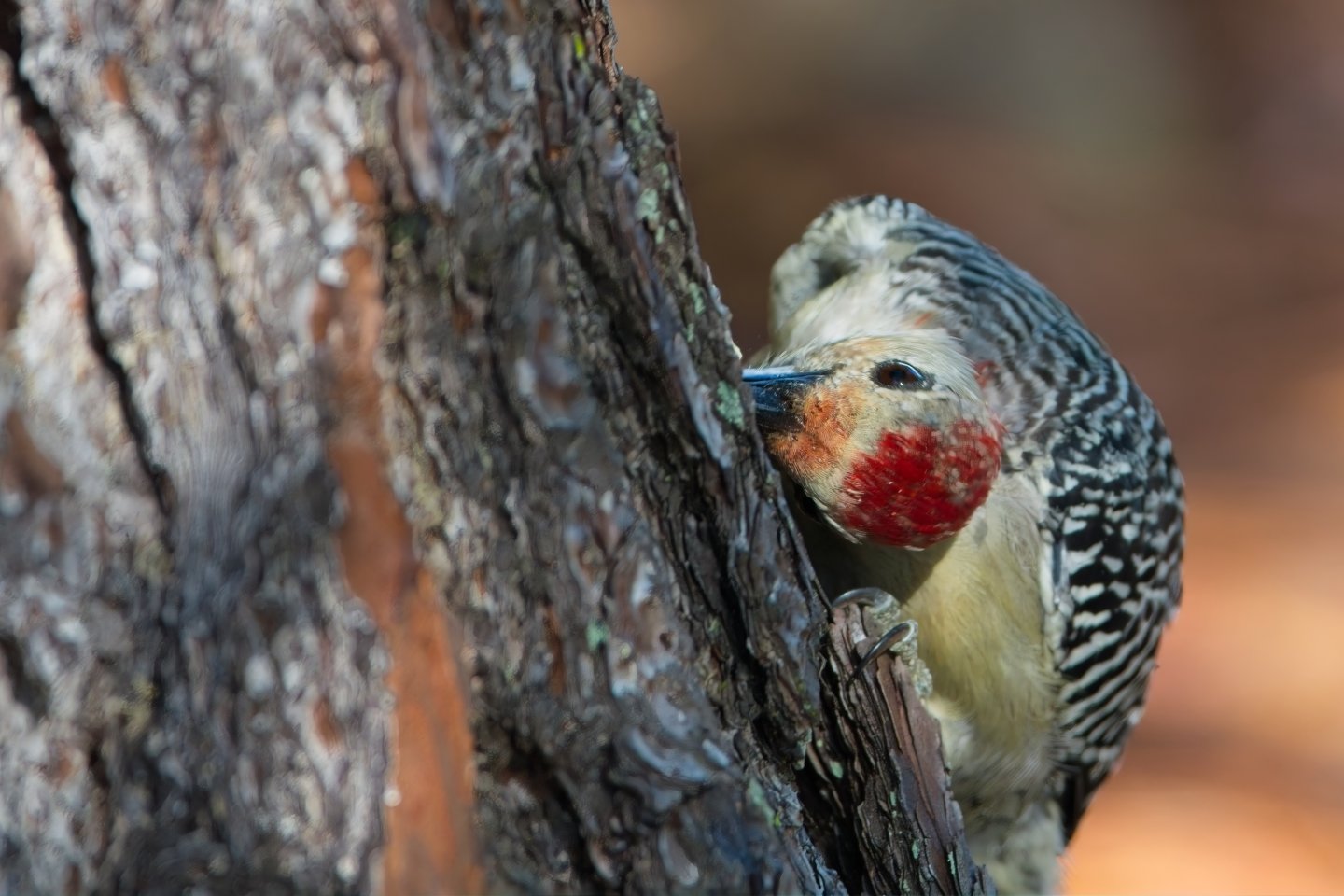
The morning light filters through the canopy of Lakes Park, casting shifting mosaics of shadow and brilliant sunlight onto the ancient trunks of oak trees. Here, amidst the lush, verdant environment of Southwest Florida, a spectacle of natural mastery unfolds with quiet intensity. Perched high upon a thick, textured branch, a Downy Woodpecker defies the conventional view, clinging upside down in an astonishing display of arboreal agility. The bird’s presence is a study in focused intent; its head is tilted gently upwards, and one watchful eye surveys the world below, suggesting a tireless exploration of the complex, three-dimensional landscape of its home. This inverted position is not merely a pose but a strategic maneuver, a testament to the specialized skill required for life among the towering branches of the park.
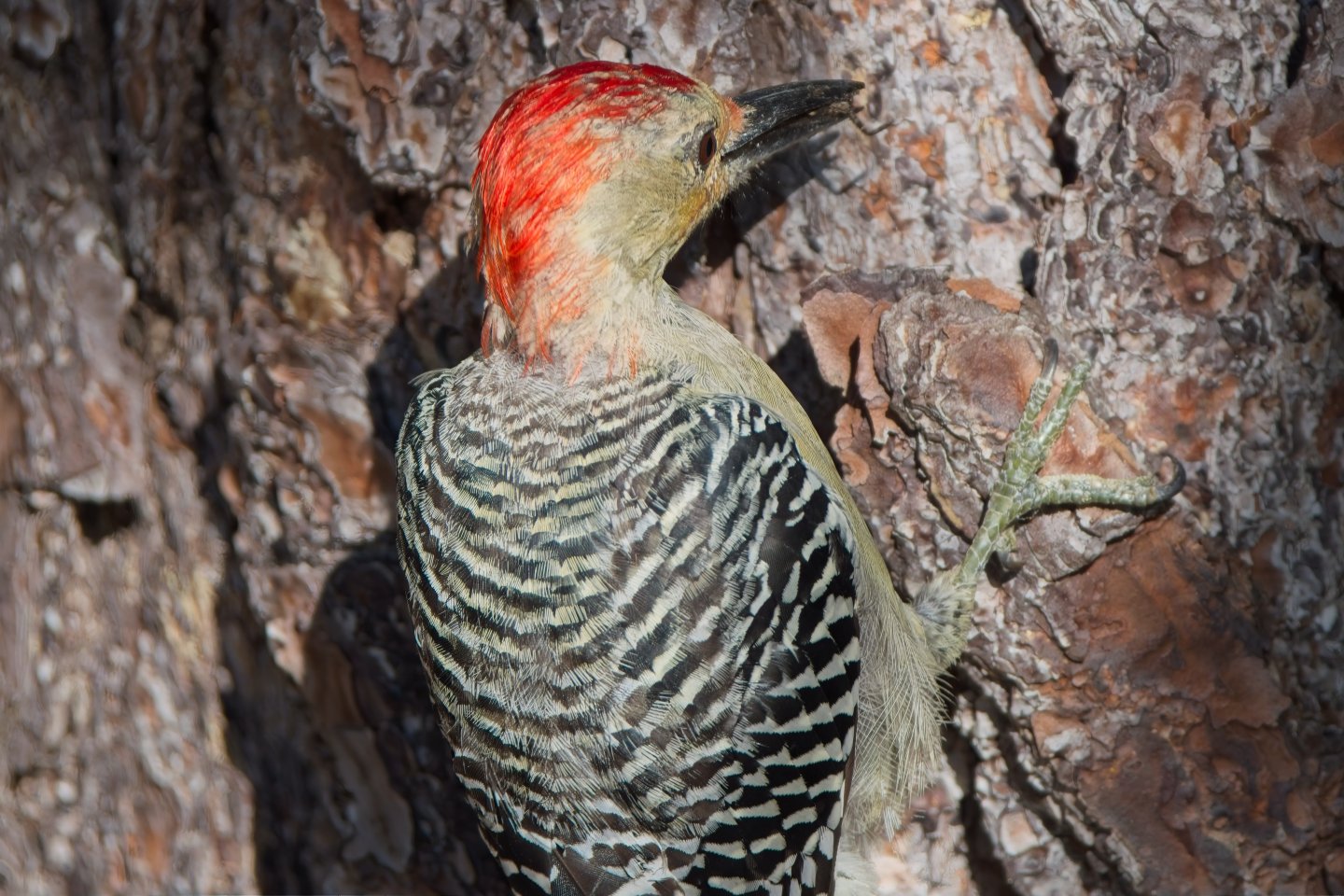
This magnificent creature, cloaked in the unmistakable pattern of black and white plumage, embodies the essence of adaptation in the forest. The bold markings—a prominent white back, a distinctly striped head, and black wings checkered with white—serve as an intricate form of camouflage, allowing the woodpecker to seamlessly blend into the dappled light and deep shadows that define the tree’s bark. As the morning sun catches its feathers, the contrast between the dark and bright patterns becomes vivid, highlighting the remarkable visual tapestry woven by nature. This striking pattern is far more than mere decoration; it is an effective tool, allowing the Downy Woodpecker to navigate its environment with effortless stealth while engaged in its essential activities.
The core of this bird’s existence revolves around its specialized method of foraging. With a short, chisel-like bill, the Downy Woodpecker possesses an adaptation perfectly honed for penetrating the rough surfaces of wood and bark. This unique structure is not just a feature but a highly evolved tool, enabling the bird to effectively probe deep into crevices, extracting vital food sources hidden beneath the outer layers of the tree. This ability allows it to access insects and larvae that form the foundation of its diet, demonstrating a profound specialization for exploiting resources within the woody environment.
The physical mechanics of this foraging strategy are equally fascinating. Unlike some of its larger relatives that might rely on stiff tail feathers for bracing themselves against gravity while working, the Downy Woodpecker relies entirely on its strong feet and sharp claws for support. These specialized appendages provide the unwavering grip necessary for clinging to precarious positions and maneuvering with precision. This reliance on powerful limbs showcases a different kind of physical engineering, enabling silent, determined movement as the bird moves up, down, and across the branches while relentlessly seeking sustenance hidden within the intricate textures of the tree.
The foraging behavior itself is a dynamic dance between instinct and physical capability. The bird’s posture—clinging inverted to the branch with its head tilted upward—is an active engagement with its environment, suggesting a focused search for food sources nestled in the bark and wood fibers. It moves with a silent determination, an agile explorer utilizing every angle available to maximize its chances of finding the insects that sustain it. This ceaseless pursuit of sustenance underscores the Downy Woodpecker’s role as an agile forager within the complex ecosystem of Lakes Park.
The presence of this species in the Southwest Florida region is deeply tied to the habitat it inhabits. The Downy Woodpecker thrives particularly well in diverse wooded environments, and in places like Lakes Park, they frequently inhabit mature tree habitats. They exhibit a clear preference for foraging on deciduous trees, such as oaks, which are abundant within the park’s landscape. This symbiotic relationship between the bird and its preferred tree species highlights how perfectly adapted this creature is to exploit the resources offered by these particular wooded environments. The presence of the Downy Woodpecker in Lakes Park signifies a thriving ecological niche where specialized adaptations allow for successful coexistence among various plant and animal life forms.
Furthermore, the size of the Downy Woodpecker plays a role in its success within this habitat. Its proportionally shorter bill is another key adaptation that allows it to access food sources across a wider range of branch sizes. It is not limited to thick trunks but can expertly navigate and extract resources from slender twigs, effectively expanding its foraging territory throughout the tree structure. This flexibility in size and tool usage enables the Downy Woodpecker to exploit a broader spectrum of available food sources, ensuring its continued success as an essential component of the park’s vibrant ecosystem.
The persistence of this species as common, year-round residents in the region is a powerful observation. It stands as a living example of how specialized physical traits and behavioral flexibility allow an animal to not only survive but to thrive within specific environmental conditions. The Downy Woodpecker's quiet persistence, characterized by its remarkable agility and specialized foraging technique, reveals a world often overlooked in the daily landscape of the park. It is a vigilant hunter, perfectly attuned to its niche, an essential thread in the park's vibrant biological tapestry. Observing this bird in its natural setting allows us a deeper appreciation for the complex web of interactions that define the health and vitality of the natural world. The Downy Woodpecker remains a compelling reminder of the intricate beauty found when nature permits such specialized forms to flourish.
Follow Adventures in Southwest Florida for more hidden wonders.