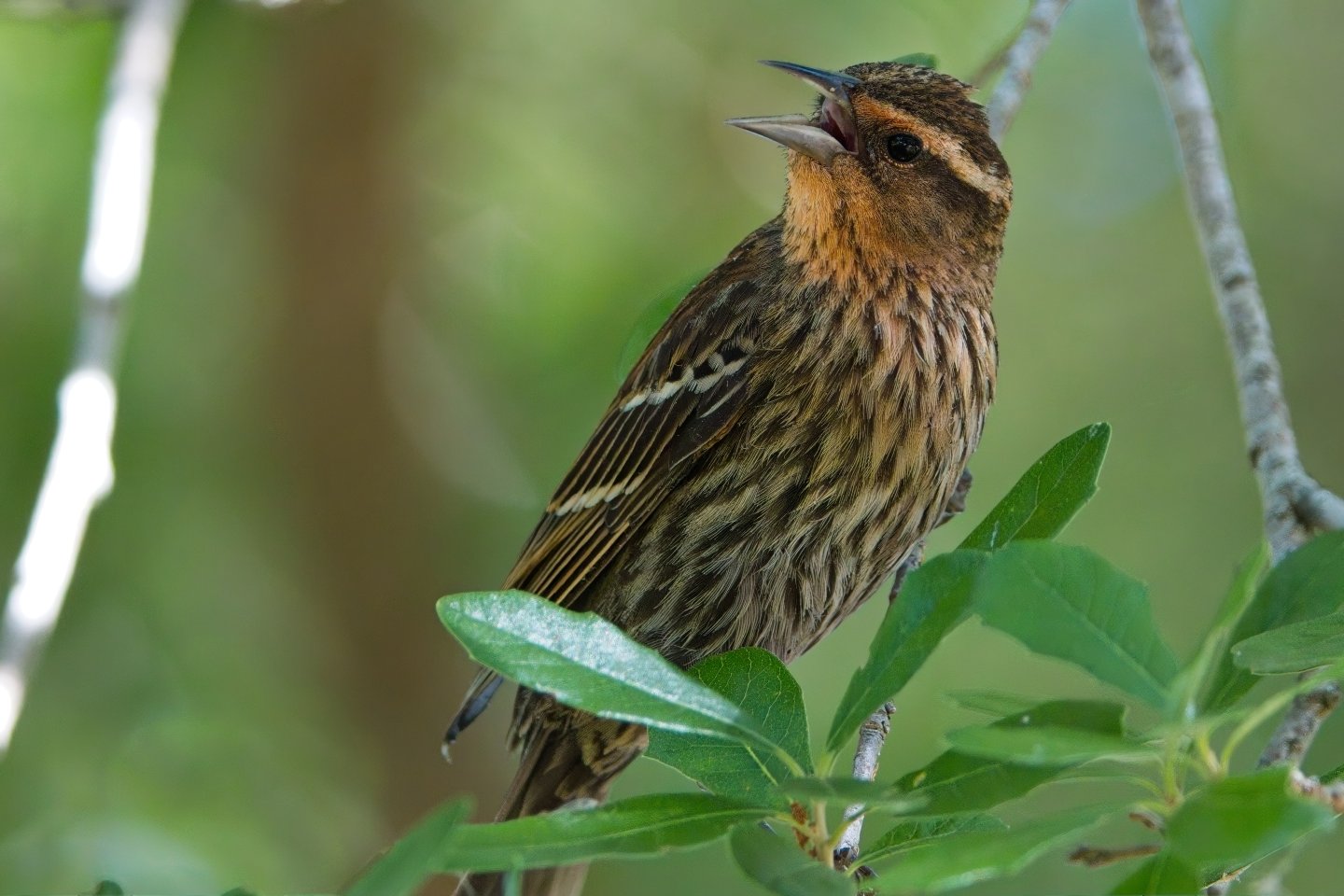
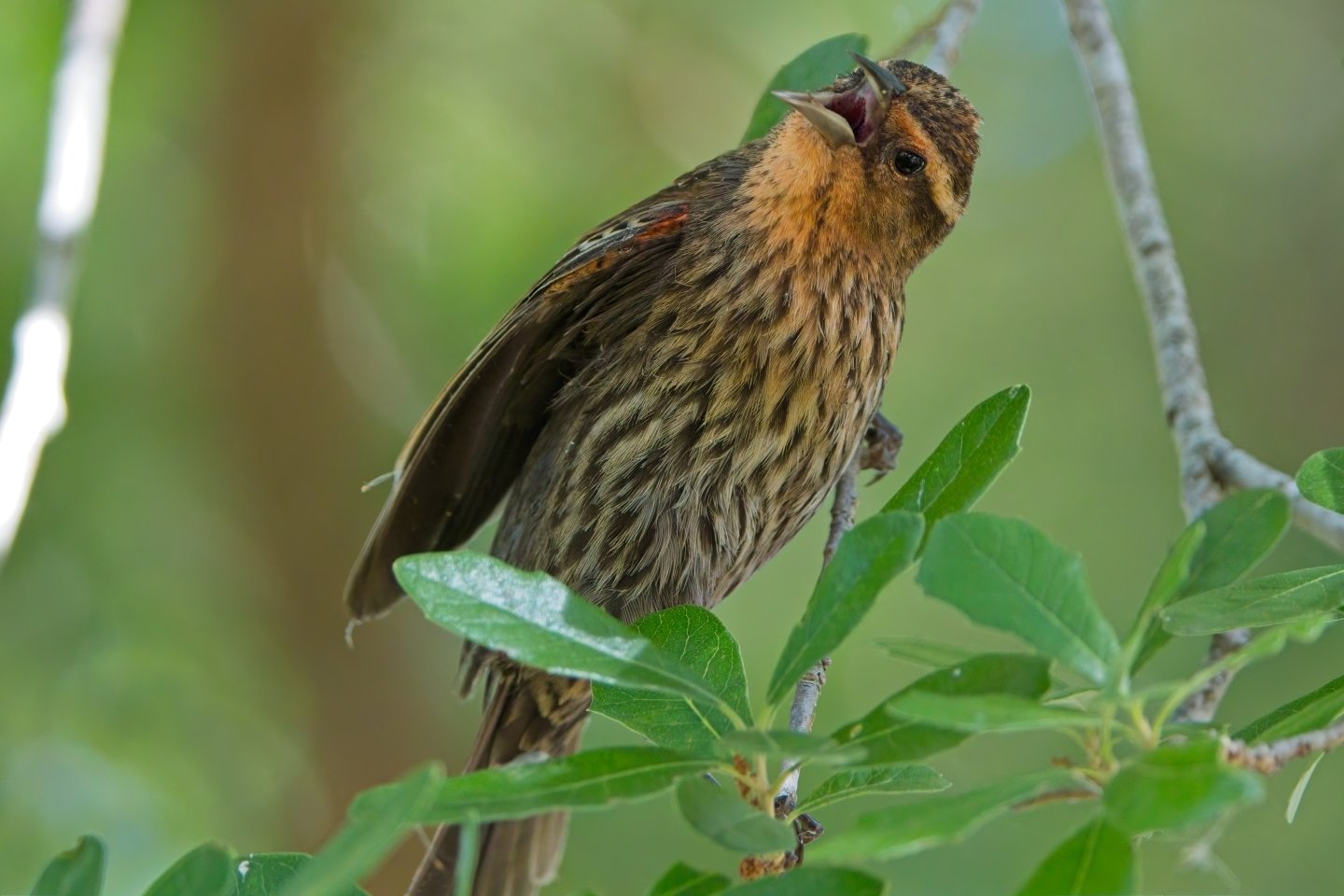
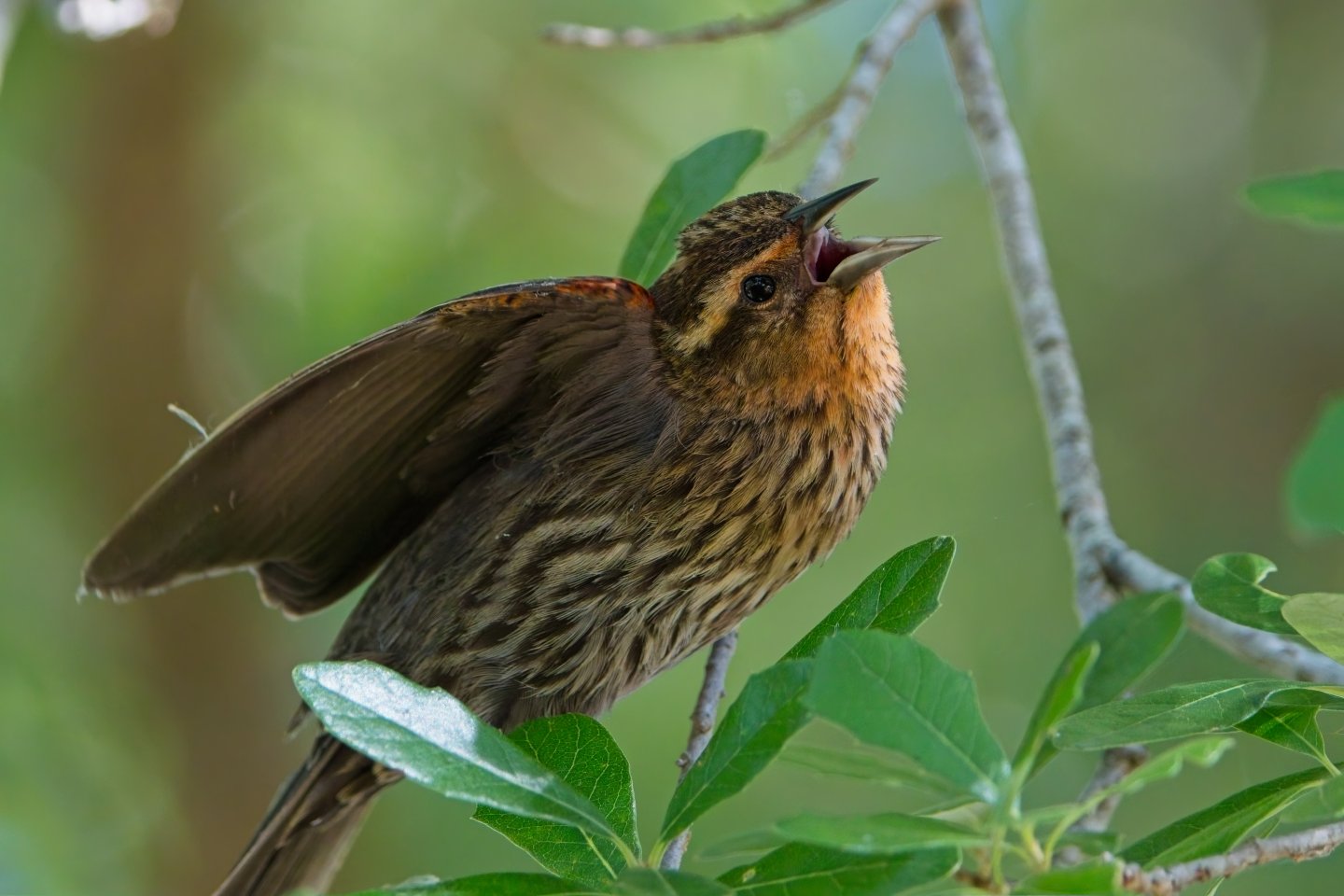
The morning light at Lakes Park casts a soft, aqueous glow over the diverse wetland edges and lush upland foliage. Here, among the dense green leaves, a powerful moment unfolds, framed by the tranquil stillness of Southwest Florida’s natural environment. Perched securely on a sturdy branch, a female Red-winged Blackbird is captured in a perfect tableau of wild communication. The bright natural light catches the texture of her feathers, highlighting a striking contrast against the soft, out-of-focus green background that signifies the vibrant life of the wetland. Her posture is one of profound focus; she is looking intently toward the right, her beak wide open, suspended mid-call or song. This gesture is not merely a display but an invitation into a complex world of sound and subtle meaning, revealing the intricate language of the avian world thriving in this unique habitat.
The atmosphere surrounding the bird is one of deep, untamed natural wonder. The lush greenery framing her provides a rich canvas against which the details of her presence emerge—a living portrait of adaptation and survival. These birds are common and often conspicuous year-round residents at Lakes Park, frequently observed moving through the park's diverse wetland and upland habitats. They are deeply interwoven with the landscape, their existence tied directly to the shifting seasons and the specific resources offered by the surrounding ecosystem. To observe them in this setting is to witness a daily performance of life, where every movement and sound holds significance within the context of their environment.
The vocalization emerging from her open beak is central to understanding this scene. It is more than just a simple sound; it is a sophisticated form of communication that serves multiple vital functions. The female Red-winged Blackbird produces a variety of calls, including a distinctive "check" call and a rapid "teer" or "chatter" sound, often delivered with an open beak to communicate across the expanse of the wetland. This vocal complexity demonstrates the depth of social interaction happening within this specific territory. These sounds are vital tools, employed for various purposes, ranging from warning calls that signal potential danger to complex interactions with their mate, and even crucial communication with their young fledglings. The sound itself acts as an immediate, potent message, echoing through the dense foliage and across the still waters of the park’s environment.
This vocal interaction is intrinsically linked to the physical reality of her appearance. Unlike the glossy black males that often dominate the landscape, the female Red-winged Blackbird presents a distinctly different visual signature. Her plumage is characterized by streaky brown feathers, lending her an earthier tone than her male counterparts. This variation is further accentuated by a paler, often buffy or whitish, breast and variable amounts of reddish or yellowish wash visible on her face or shoulder. This unique coloration allows her to navigate the dense cover of trees and shrubs effectively, blending into the rich tapestry of the wetland edges while still possessing a distinctive identity. The visual details paint a picture of a bird perfectly adapted to its specific niche within the Florida landscape.
The life cycle unfolding at Lakes Park is dictated by the rhythm of the seasons. During this period, the breeding season unfolds from early spring into mid-summer, a time when the entire environment becomes alive with activity. For the females, this phase is intensely demanding and purposeful. They dedicate themselves wholly to the monumental tasks of building nests, carefully incubating eggs, and raising their young. This focused effort dictates much of their behavior within their territories, leading to frequent vocalizations as they establish and maintain their presence. The energy expended in these reproductive efforts underscores the significance of every interaction witnessed among the birds.
The construction of the nest is a highly meticulous process undertaken exclusively by the female. She works with incredible precision, weaving together plant materials such as grasses, sedges, and leaves to construct a delicate, cup-shaped structure. This creation process involves more than just gathering materials; it demands artistry and deep knowledge of the local flora. Furthermore, this structure is often reinforced with mud before being lined with fine dry grasses, creating a sturdy and concealed sanctuary for her developing brood. These hidden nests are typically situated low to the ground and well-hidden amongst the dense foliage of shrubs or small trees, offering essential protection from the elements and potential disturbances. This hidden structure becomes the very epicenter of her world during these critical weeks.
The establishment of territory is another profound aspect of the female’s behavior. While Red-winged Blackbirds are often associated with larger male territories, the females possess the autonomy to establish their own small individual nesting territories within a larger male's domain. This act signifies an assertion of ownership and a need for specific security for their brood. Furthermore, these females engage in active defense of their chosen nest site, meticulously warding off other females who might encroach upon their carefully secured space. This dynamic territorial behavior highlights the complex social negotiations that occur within this avian community, underscoring the fierce dedication to protecting the developing life within.
The sustenance required for such intense biological activity also plays an important role in the bird’s daily existence. The diet of Red-winged Blackbirds undergoes a significant shift according to the seasonal demands of the environment. During the breeding season, when energy expenditure is highest, their food sources concentrate on readily available insects and spiders, providing the necessary fuel for nesting and raising young. As the seasons transition into non-breeding months, the dietary focus shifts, with the birds switching to consuming seeds and grains as other resources become more abundant. This seasonal adaptation illustrates a remarkable ability of these birds to synchronize their survival strategies with the cyclical changes of the Florida environment.
The presence of these magnificent birds at Lakes Park serves as a constant reminder of the delicate balance within nature. They are not merely inhabitants of the park; they are active participants in its ecological health, their calls and behaviors contributing to the vibrant narrative of Southwest Florida’s wetland and upland habitats. Observing them in bright light, engaged in the complex choreography of calling, nesting, and defending, offers a profound perspective on the enduring strength of life in this natural setting. Their presence reminds us that beneath the surface of the everyday landscape lies a rich, dynamic world of communication, dedication, and survival, all unfolding in harmony with the rhythms of nature.