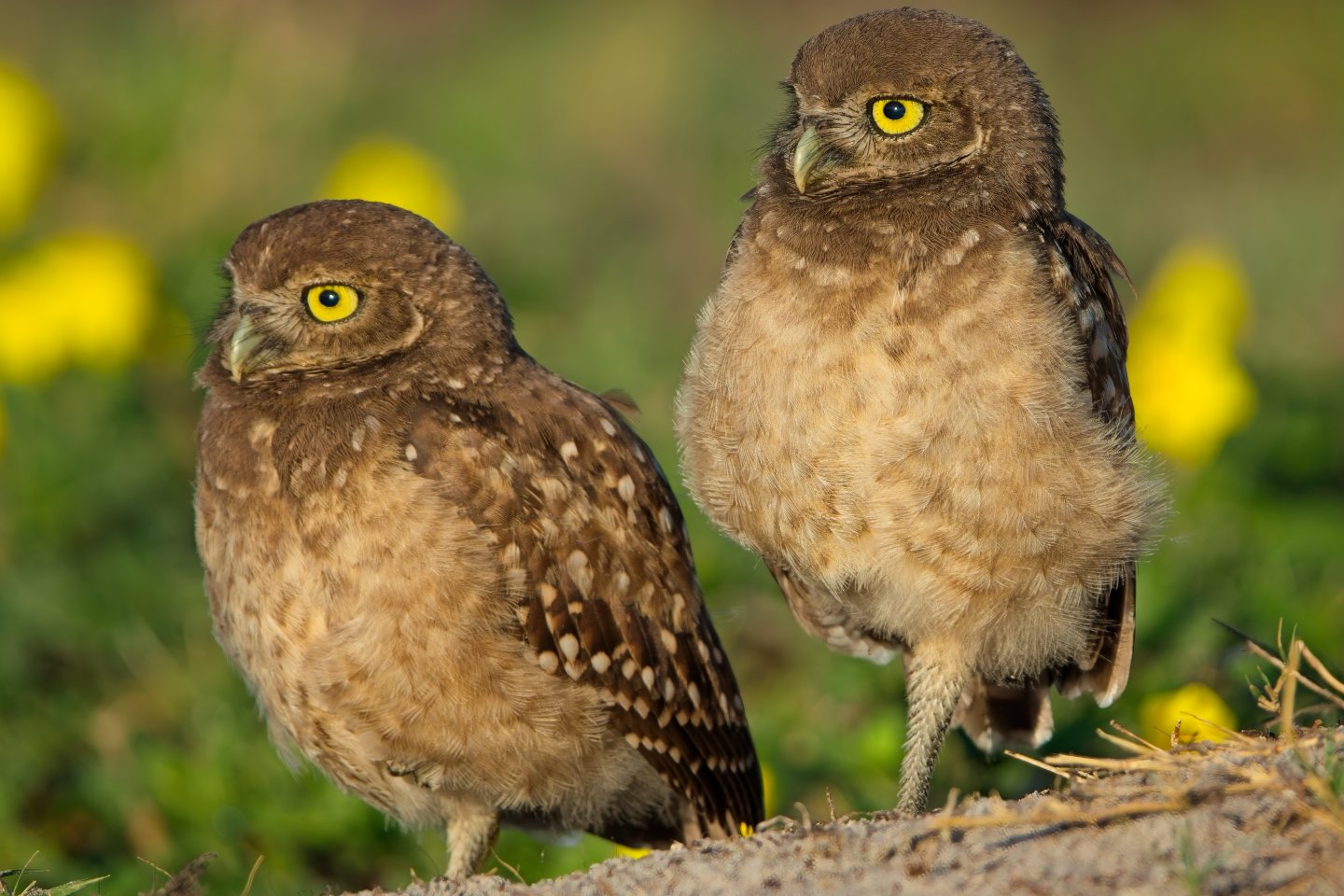
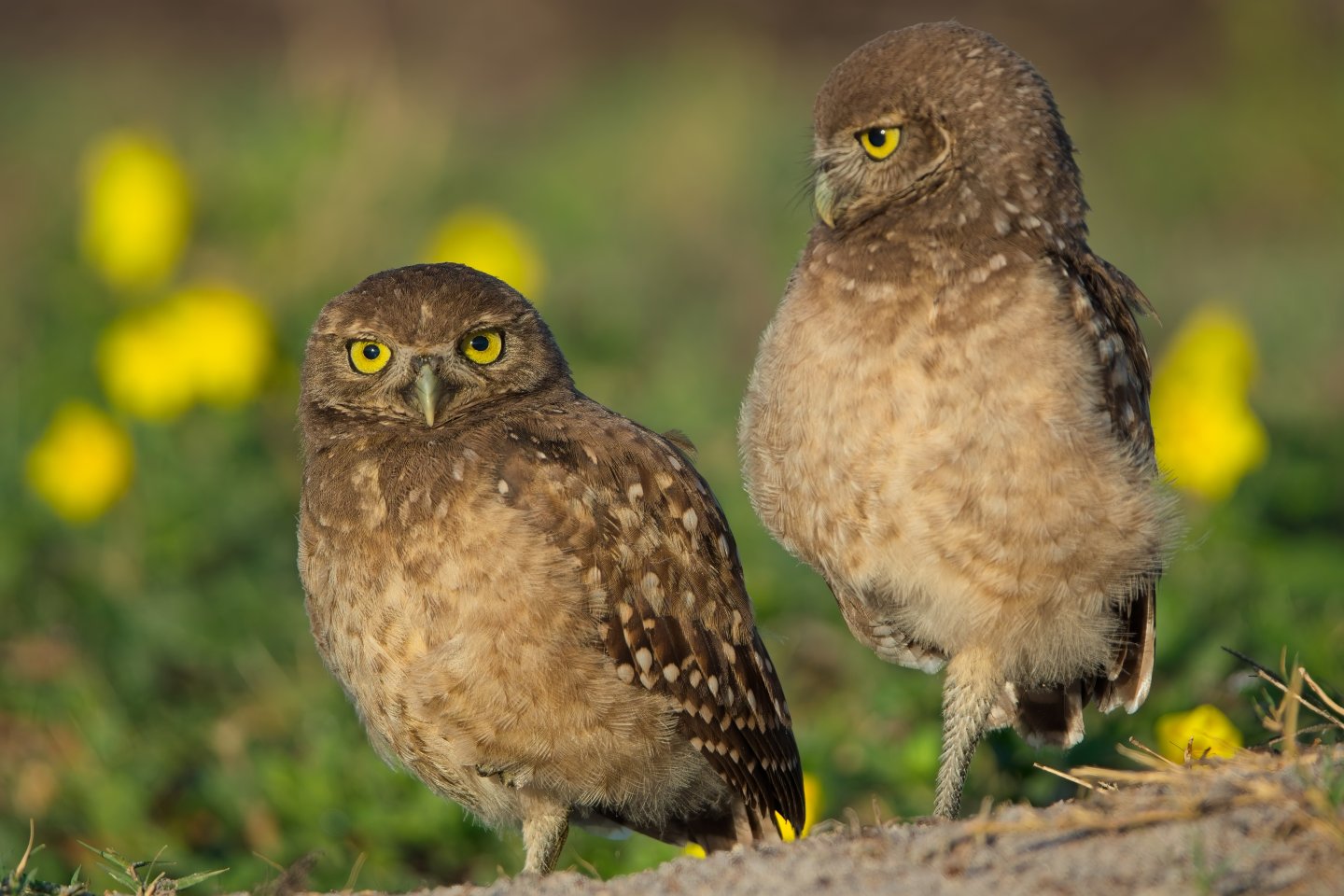
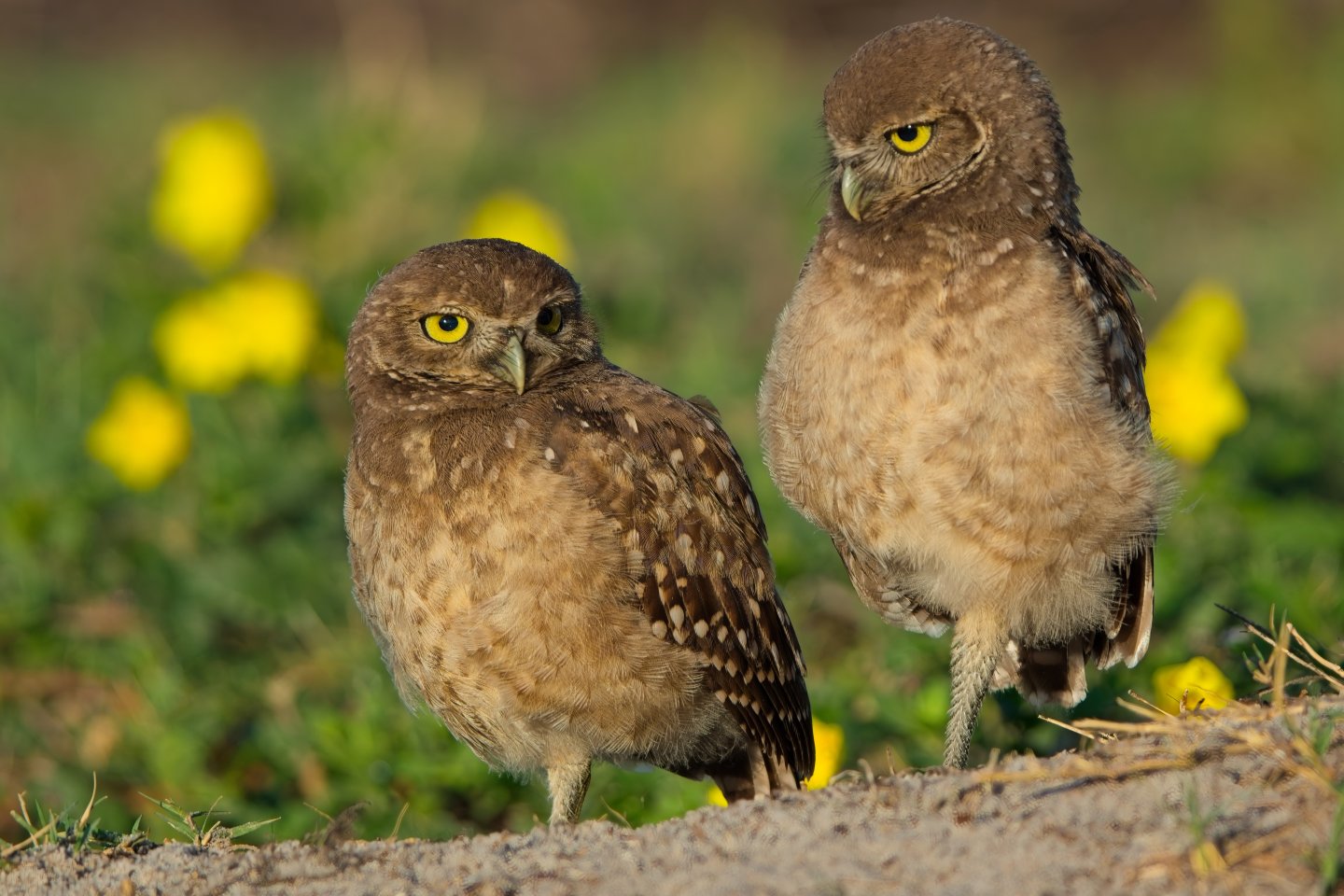
A solitary, vivid yellow eye pierces the morning light, a focal point against the soft hues of a subtropical landscape. On a patch of light-colored ground at the Pelican Baseball Complex, two Burrowing Owls stand prominently, embodying a quiet, profound presence within the manicured environment of Southwest Florida. The scene is one of stillness, a moment captured where wild instinct meets suburban sprawl. The owl on the right is poised delicately on one leg, its posture suggesting a brief pause in activity as it scans the surroundings, while the owl on the left faces forward with steady attention. The natural light illuminates their cryptic brown and tan plumage, finely speckled with white, which allows them to blend seamlessly with the sandy earth they inhabit. Against this backdrop of earthy tones, their vivid yellow eyes stand out—brilliant orbs that possess an almost startling clarity, set against a softly blurred background of lush green grass dotted with the bright yellow of unseen flowers.
This image is more than just a photograph; it is a portrait of resilience and adaptation in a landscape that has been dramatically reshaped by human presence. Here, within the expansive grounds of the Pelican Baseball Complex, these small raptors have established themselves as masters of their environment. Their presence speaks to a remarkable ability to integrate into spaces previously dominated by human activity, demonstrating how nature finds enduring sanctuary even where the boundaries between wilderness and suburb are increasingly blurred. The context of Southwest Florida, particularly regions like Cape Coral, serves as an exceptional stronghold for these unique birds, a place where the natural world persists alongside modern living.
The habits observed in this setting reveal a deep understanding of survival within human-modified landscapes. Burrowing Owls demonstrate a profound adaptability, readily adapting to suburban environments by utilizing open, grassy areas such as sports fields and residential lawns as suitable habitats. They seek out well-drained, open ground where vegetation is kept short, providing the unobstructed views necessary for their nocturnal hunting strategies. This preference for open spaces means that mowed areas, like the expanse of a baseball complex field, offer ideal conditions for these owls to establish themselves and thrive.
Their architectural choices underscore this adaptation. While some owls may utilize abandoned structures in other parts of the state, within urbanized Southwest Florida, they frequently engage in excavating their own burrows directly into the sandy soils that characterize the region. They also show ingenuity by adapting to using culverts or incorporating artificial starter burrows into the human-modified landscapes surrounding them. This capacity to modify and utilize the physical space around them highlights a sophisticated relationship with their surroundings.
The visual camouflage of the Burrowing Owl is perhaps one of its most striking features. Their plumage, a complex tapestry of brown and tan flecked with white spots, provides effective concealment against the bare ground and sparse vegetation of their open habitats. This cryptic coloration is a masterclass in disguise, allowing them to remain largely unseen by potential threats while they survey their domain. Yet, when the light catches those vivid yellow eyes, there is an undeniable intensity—a testament to keen observation and the sharp focus required for survival in a dynamic environment.
The way these owls interact with their immediate space reveals fascinating biological details. Like many birds, the posture displayed by one owl in the foreground is a natural mechanism, where one leg is tucked into the feathers, a behavior employed to reduce heat loss or simply to rest the limb during a period of vigilance. This simple physical act is a subtle illustration of the fine-tuned ways these creatures manage their energy and comfort while remaining acutely aware of the world around them.
Further insights into their daily existence reveal an unexpected layer of complexity in their subterranean lives. Burrowing Owls exhibit remarkable ingenuity in decorating or lining their burrows with mammal dung. This seemingly unusual habit serves multiple critical functions for the birds. It plays a role in masking their scent from lurking predators, effectively concealing their presence from potential dangers that might prowl the open landscape. Furthermore, this lining assists in regulating the temperature within the burrow, providing a stable microclimate essential for nesting and raising young. In some instances, this lining may even attract insects, which serve as an important food source for the growing chicks within, adding another layer to their resource management strategies.
The rhythm of the Burrowing Owl’s day is intrinsically linked to the cycle of light and shadow. They are highly diurnal birds, meaning they are active hunters and foragers throughout the daylight hours, utilizing the ample light available to them. However, their heightened awareness extends beyond the sunlit hours; they remain alert at dawn and dusk, when the light transitions, often engaging in periods of intense observation for both prey and potential threats. This dual activity demonstrates an intricate balance between active foraging and watchful waiting.
This constant state of alertness is further emphasized by their ability to communicate warnings. Both adult and juvenile Burrowing Owls possess a unique alarm call that is remarkably effective. This sound mimics the distinctive buzzing rattle of a rattlesnake from inside their burrows, a startling auditory signal designed to deter any potential intruders or predators. This innate warning system underscores their role as vigilant guardians of their territory.
The very act of standing motionless, intently observing everything around them for both sustenance and safety, is characteristic of their nature. They possess an almost statue-like stillness, allowing them to maximize their sensory input and process the complex information of their surroundings with incredible focus. This vigilance is a defining trait of these small raptors, reflecting a deep-seated instinct for self-preservation in an ever-changing world.
The presence of Burrowing Owls in places like the Pelican Baseball Complex offers a poignant commentary on the relationship between wildlife and human development. They are living examples of how nature does not simply tolerate human expansion but rather finds a way to adapt, carve out a niche, and flourish within it. Their thriving existence among manicured fields is a testament to an enduring adaptability and a quiet strength.
The image presented—the juxtaposition of wild beauty and suburban order—encapsulates a deeper truth about the environment we inhabit. It reminds us that even in highly developed areas, pockets of wildness persist, sustained by the natural processes of adaptation and survival. These owls are not merely visitors; they are integral inhabitants who navigate the subtle yet profound intersections of the natural world and the human-made landscape, continuing their silent, watchful existence among the green spaces of Southwest Florida.
Follow Adventures in Southwest Florida for more hidden wonders.
No comments:
Post a Comment