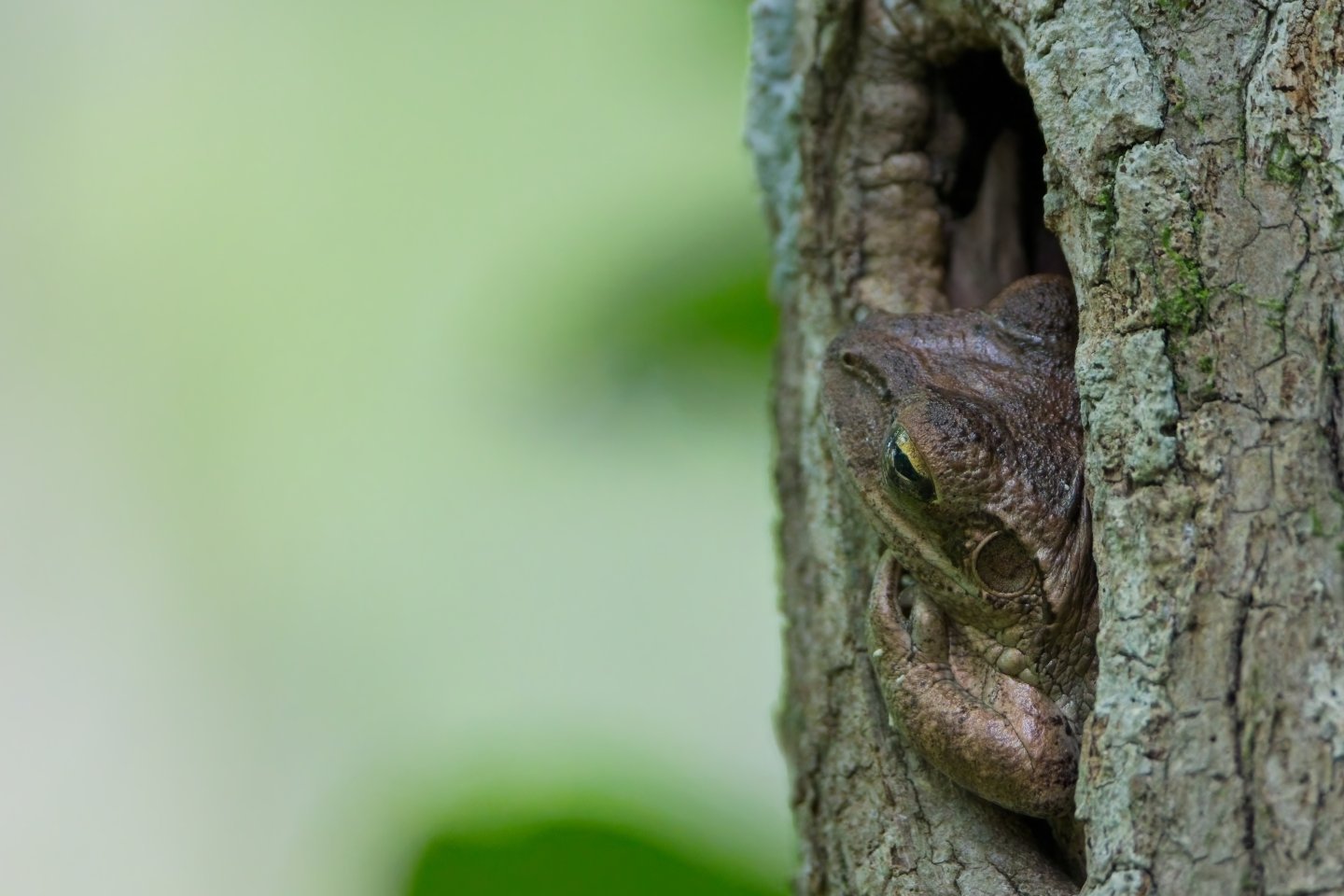
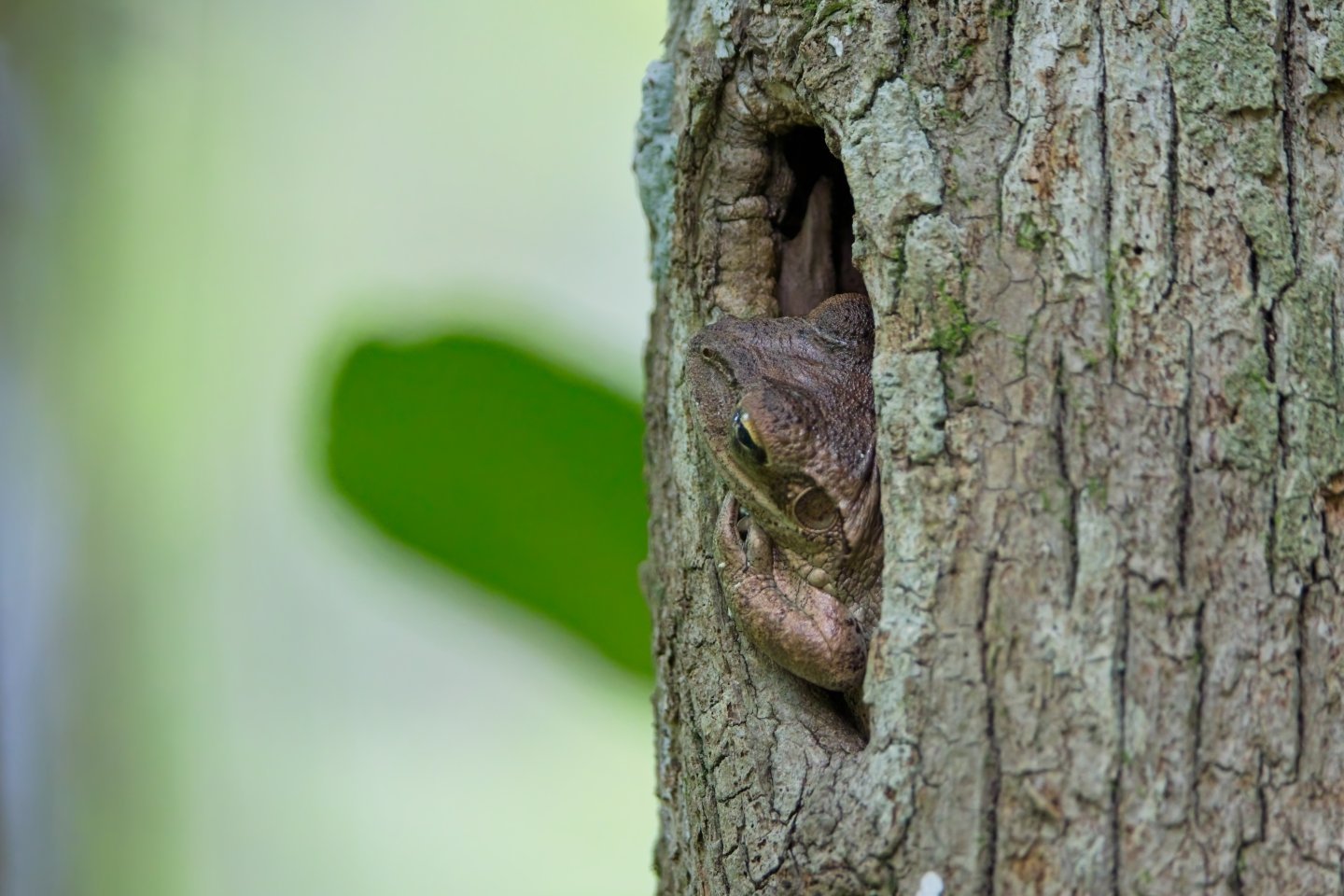
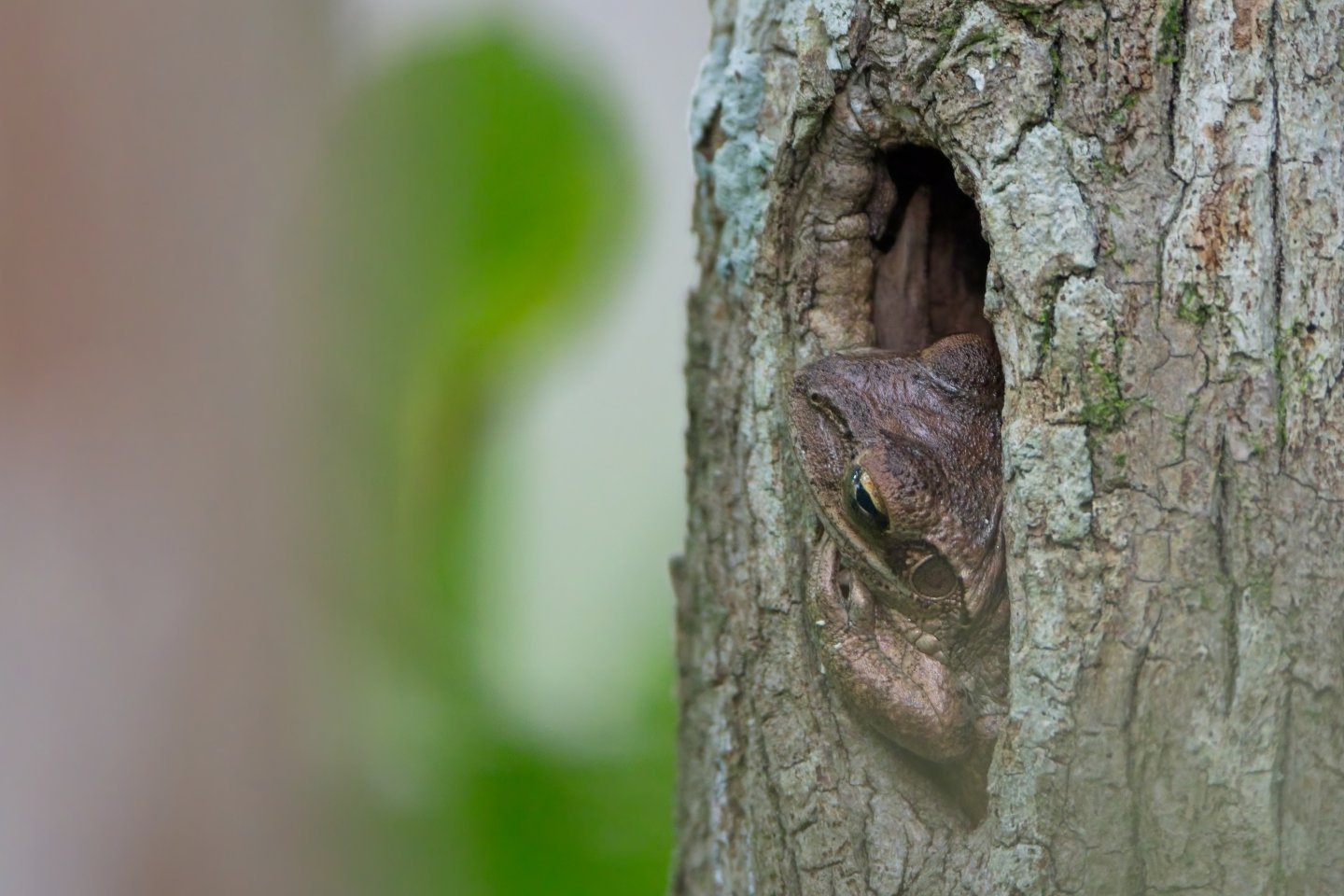
The soft, diffused light of the morning filtered through the dense canopy, casting dappled patterns across the damp earth of the Six Mile Cypress Slough Preserve. It was in this verdant, humid realm that a hidden world was revealed—a glimpse into the secluded existence of the Cuban Tree Frog. Peeking out from a dark cavity nestled within the rough bark of a tree trunk, the frog offered a portrait of quiet resilience. Its textured skin caught the light, highlighting the subtle shifts in color and the prominent focus of its eye, drawing the viewer into an intimate encounter with this remarkable amphibian. This moment, captured amidst the lush green foliage, is more than just a wildlife sighting; it is an invitation to consider the delicate balance of life thriving within these wetland habitats.
This unassuming creature, native to the Caribbean, has found a foothold in the unique ecosystem of Southwest Florida wetlands, transforming the Cypress Slough Preserve into a vital habitat for this arboreal invader. The presence of the Cuban Tree Frog introduces fascinating dynamics to the local environment. To understand its place here, one must look at how it navigates its world and interacts with its surroundings. Its physical adaptations are finely tuned for survival in this mixed terrestrial and aquatic environment. For instance, the frog possesses webbed feet, a structure that enables it to move efficiently through water, allowing seamless transitions between the damp ground and the surrounding aquatic systems. This dual capability is essential for navigating the intricate landscape of the preserve, where dense vegetation meets open water.
The mastery of climbing is equally striking. These arboreal inhabitants are not merely restricted to the surface; they possess large toe pads that act as natural suction cups, allowing them to climb smooth bark and various vertical surfaces with incredible ease. This ability to ascend into tree cavities or onto structures in dense vegetation speaks to a sophisticated understanding of their environment, providing secure hideaways from predators and the elements. This capability highlights how fully integrated the frog is within the tree-lined landscape of the preserve.
Survival in this environment is heavily dependent on the frog’s ability to camouflage itself. The skin color of the Cuban Tree Frog is not static; it is a dynamic tool used for survival and concealment. Depending on whether it is resting against mossy bark or blending into the forest leaf litter, the skin can change its hue from a vibrant green to a more muted brownish-green. This remarkable adaptation allows them to blend seamlessly with their surroundings, offering crucial camouflage against both predators on land and trees. This sophisticated color change is a masterclass in natural disguise, demonstrating how camouflage is key for this master of disguise to evade danger while resting or waiting for opportunities.
The feeding habits of the Cuban Tree Frog are also uniquely adapted to its wetland habitat. Unlike some strictly arboreal species, these frogs are often found utilizing the ground surface within wetland areas. They employ a patient strategy, primarily feeding by sitting and waiting near light sources or in areas where movement attracts insects—a testament to their reliance on subtle environmental cues for sustenance. This behavior connects them directly to the pulse of the local ecosystem, demonstrating an intimate relationship with the insect life that forms the base of their food chain.
However, this successful adaptation comes with ecological complexities. As an invasive species within the Six Mile Cypress Slough Preserve, the presence of the Cuban Tree Frog introduces competitive pressures into the local amphibian community. The frog competes with and preys upon native amphibians already inhabiting the preserve, including populations of the native Southern Leopard Frog. This interaction underscores a critical theme in studying wildlife: the introduction of new species alters established ecological relationships, creating shifts in population dynamics and competitive interactions within the habitat. Understanding this dynamic is essential for preserving the overall biodiversity of the region.
Furthermore, the acoustic environment of the preserve is subtly altered by the presence of this frog. The loud "ribbit" call produced by the Cuban Tree Frog is quite distinct when compared to the sounds of native species, such as the nearby Pickerel Frog. This auditory presence adds a new layer to the soundscape of the wetland, creating an audible signature of this invasive species that distinguishes it from the native amphibian chorus. This shift in sound not only affects how the frog communicates but also contributes to the complex sonic tapestry of the entire environment.
The protection afforded to this species is recognized, reflecting a balance between its status as an ecologically significant inhabitant and its role as an expanding presence throughout Southwest Florida wetlands. The Cuban Tree Frog’s story at the Six Mile Cypress Slough Preserve is a compelling example of how nature constantly adapts and reshapes itself. It challenges our perceptions of what constitutes a native ecosystem and reminds us that every species plays a complex, interconnected role in the larger picture of the wild world. Observing this frog in its natural setting allows us to appreciate the intricate details of biodiversity and the ongoing, dynamic processes of life unfolding around us.
Follow Adventures in Southwest Florida for more hidden wonders that challenge our perceptions of nature's harmony.
No comments:
Post a Comment